
ROQ.US Tech Tip: Thin Thread Mesh vs. Standard Mesh: A Real-World Look at Brighter, Smoother White Prints

White ink is one of the most demanding parts of screen printing. It needs to be opaque, smooth, and bright, but it also needs to print efficiently without forcing the operator to overload pressure, overwork the garment, or fight the screen. During the Shirt Show Super Base Camp at The ROQ Tech Center, Kevin from SATTI demonstrated a practical side-by-side comparison that showed just how much mesh selection can affect print quality.
The test compared a standard SAATI HITEX mesh with a comparable thin thread mesh, using the same ink, same squeegee setup, same print stroke, and the same printing conditions. The only major variable was the mesh itself. The results made one thing clear: thin thread mesh can dramatically improve ink transfer, brightness, and print smoothness, especially when printing white ink or building white underbases.
The Setup: Same Conditions, Different Mesh
The goal of the demonstration was simple. By keeping the production variables consistent, the test could isolate the difference between a standard mesh and a thin thread mesh. The prints were tested on two different garment types: an open-end 18 singles shirt and a 30 singles compact spun shirt.
Test Variable | Details |
Standard mesh | SAATI HITEX 156 |
Thin thread mesh | SAATI thin thread 157 |
Garment type 1 | Open-end 18 singles |
Garment type 2 | 30 singles compact spun |
Off-contact | Approximately 4 mm |
Squeegee pressure | Approximately 40 lb |
Ink and squeegees | Same on both tests |
Print stroke | Same stroke on both sides of the screen |
This setup matters because it mirrors the kinds of decisions printers make every day. A shop may be using the same ink and press settings, but if the screen is not transferring ink efficiently, the finished print can look weak, rough, or inconsistent.
The Mesh Difference: Open Area Changes Everything
The standard SAATI HITEX mesh used in the test had a 64-micron thread diameter, a 90-micron opening, and a 32% open area. The thin thread 157 mesh had a 48-micron thread diameter, a 109-micron opening, and a 46% open area.
That difference in open area is significant. While the mesh counts are nearly the same, the thinner thread creates more room for ink to pass through the screen. In practical terms, the thin thread mesh provides over 30% more open area than the standard mesh.

Mesh Type | Mesh Count | Thread Diameter | Mesh Opening | Open Area |
Standard SAATI HITEX | 156 | 64 microns | 90 microns | 32% |
SAATI thin thread | 157 | 48 microns | 109 microns | 46% |
On press, that extra open area can translate into more ink deposit, better screen clearing, and a brighter print. This is especially important when printing white ink, where opacity and coverage are often the biggest challenges.
The key takeaway from the demonstration was that mesh count alone does not tell the whole story. Two meshes with nearly identical counts can behave very differently depending on thread diameter, opening size, and percentage of open area.
Printing on Open-End 18 Singles
The first garment tested was an open-end 18 singles shirt. This type of fabric typically has a rougher surface compared with a finer ring-spun or compact spun garment. Because of that texture, white ink often needs more help filling the surface and producing an even, bright result.
With the standard HITEX mesh, the first print did not clear the screen cleanly in one pass. The second pass produced a better result, but the initial print showed the limitations of the standard mesh when trying to achieve strong white coverage without increasing pressure or changing technique.
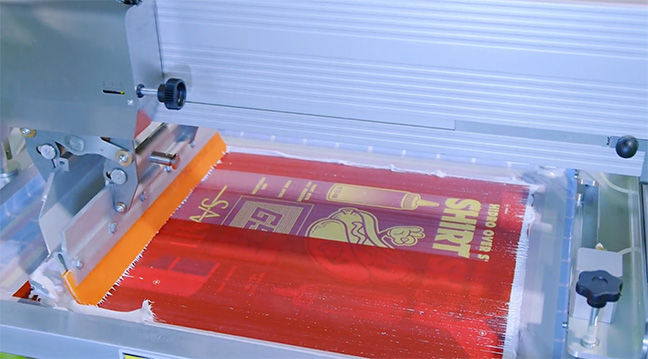
The thin thread mesh performed noticeably better. As the ink began to flow and the screen opened up, the thin thread side produced a brighter, smoother result with less effort. The difference was visible on both the first and second open-end shirts, with the thin thread mesh delivering stronger coverage and a cleaner print surface.
Garment | Standard Mesh Result | Thin Thread Result |
Open-end 18 singles, first print | Weaker coverage and less clean screen clearing | Brighter and more complete ink transfer |
Open-end 18 singles, second print | Improved as ink began flowing | Still visibly smoother and brighter |
The open-end fabric made the contrast especially obvious. Because the garment surface is more textured, the benefits of improved ink transfer showed up quickly.
Printing on 30 Singles Compact Spun
The second garment tested was a 30 singles compact spun shirt. This fabric has a smoother surface, which generally makes it easier to achieve a clean print. As expected, both meshes performed better on the compact spun garment than they did on the open-end 18 singles shirt.
However, the thin thread mesh still produced the stronger result. The difference was not quite as dramatic as it was on the open-end fabric, but it was still visible. The print from the thin thread mesh appeared smoother, brighter, and easier to achieve without forcing the setup.
Garment | Standard Mesh Result | Thin Thread Result |
30 singles compact spun, first print | Better than on open-end fabric, but still less open and bright | Smooth, bright, and more efficient coverage |
30 singles compact spun, second print | Improved, but still behind thin thread performance | Very smooth print with strong brightness |
This part of the test reinforces an important point. Better garments can help improve print quality, but mesh selection still matters. Even on a smoother shirt, the thin thread mesh gave the ink more opportunity to pass through the screen and build a cleaner white print.
Why Thin Thread Mesh Helps White Ink
White ink is thicker and less forgiving than many other colors. When a screen does not clear well, printers may compensate by increasing squeegee pressure, slowing the stroke, adding extra print passes, or adjusting off-contact. Those changes can solve one problem while creating others, such as fibrillation, rough hand, dot gain, or inconsistent coverage.
Thin thread mesh helps because it gives the ink a more efficient path through the screen. The thinner thread diameter creates a larger opening and a higher percentage of open area, which means the printer can often achieve better coverage without dramatically changing press technique.

Production Challenge | How Thin Thread Mesh Can Help |
Weak white opacity | Allows more ink to transfer through a similar mesh count |
Poor screen clearing | Provides larger openings for easier ink passage |
Excessive squeegee pressure | May reduce the need to compensate with pressure |
Rougher garment surfaces | Helps deposit enough ink to cover texture more evenly |
White underbase building | Supports brighter, smoother underbases with less effort |
For shops printing a lot of white ink, athletic graphics, bold spot color designs, or plastisol underbases, this can be a meaningful improvement. The test showed that even when ink, squeegee, pressure, and stroke remained the same, the final results were very different.
The Practical Lesson for Screen Printers
The biggest lesson from the demonstration is that not all mesh with similar counts performs the same way. A standard 156 mesh and a thin thread 157 mesh may look close on paper if the printer only considers mesh count. But once thread diameter, mesh opening, and open area are included, the difference becomes much more important.

For printers who regularly struggle with white ink opacity or underbase brightness, thin thread mesh is worth serious consideration. It can help improve ink transfer without immediately resorting to more pressure, more strokes, or heavier ink deposit through lower mesh counts.
That does not mean thin thread mesh is the answer for every job. The best choice still depends on the artwork, ink system, garment, stencil, tension, press setup, and desired hand feel. But this demonstration showed that when the goal is a smooth, bright white print, thin thread mesh can provide a clear production advantage.
Final Takeaway
The side-by-side comparison at The ROQ Tech Center made the result easy to see. On both open-end 18 singles and 30 singles compact spun garments, the thin thread mesh delivered a brighter, smoother print with better ink transfer. The difference was most dramatic on the rougher open-end garment, but it remained visible even on the smoother compact spun shirt.
The conclusion is straightforward: same ink, same squeegee, same stroke, same press settings — but very different results. If your shop prints a lot of white ink or builds a lot of white underbases, thin thread mesh may be one of the simplest upgrades you can make to improve print quality and production consistency.
See the IMPRESS in Action at the ROQ US Tech Center
Reading about automation is one thing. Seeing it run in a real production environment is something else entirely.
Visit the ROQ US Tech Center in Clermont, Florida for a personalized live demonstration of the ROQ IMPRESS. We'll walk through real-world workflows, demonstrate different configurations, and help you understand exactly how the Impress could fit into your operation.
Whether you're looking to reduce labor, increase throughput, improve consistency, or evaluate ROI, there's no better way to explore the possibilities than seeing the equipment firsthand.
Schedule your private demo today and experience the future of heat transfer automation for yourself at the form below:


.png)


Comments